October, 2023
Due to a recent surge in digitalization, the government’s provisions of Open data have proven to be extremely useful to the public as well as to the government in curating the public’s needs. This analysis aims to discuss how open data helps improve transparency and democratic control by giving people the right to knowledge and participation. “Open data have made research logistically possible not only for many scientists during the pandemic but also for those with limited resources. This has been especially true for early career scientists who may not have had adequate time to accrue their own large datasets.” (Record et al., 2022) In this analysis, we will explore the open dataset “Deaths Involving COVID-19 by Vaccination Status” from Ontario’s Open Data Catalogue. This dataset contains information on COVID-19-related deaths, categorized by vaccination status and age group. This dataset upon analysis aims to provide insights into the impact of vaccination on COVID-19 mortality rates in Ontario. Datasets such as this one proves to be invaluable to the public health sector as this helps the government gauge temporal trends in vaccination and mortality and roll out doses in accordance. The dataset also emphasizes the significance of tailored vaccination efforts for various age groups, with a focus on vulnerable populations. The information gathered can be used to guide public health policy and vaccination drives in Ontario to reduce COVID-19 cases and help individuals shield themselves during the pandemic.
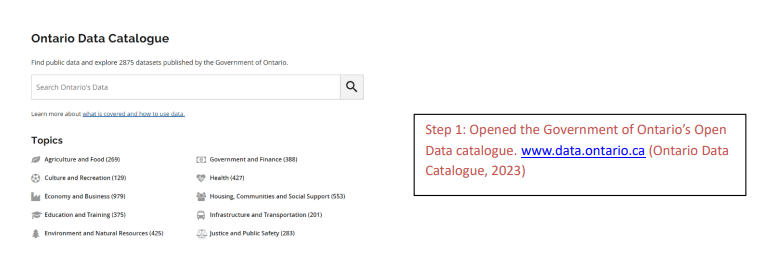
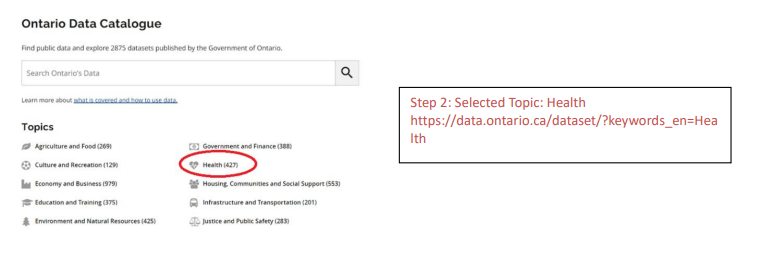
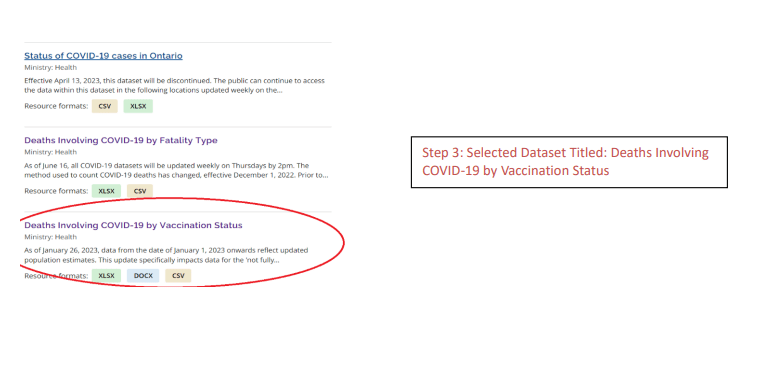
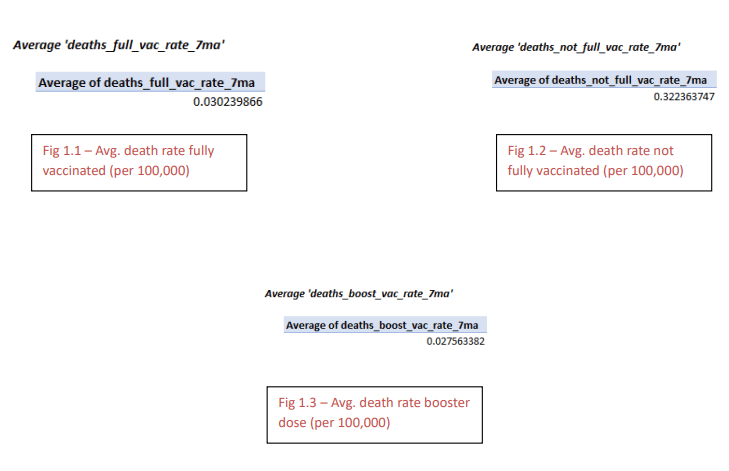
Upon analyzing the dataset using Microsoft Excel’s Analysis Tool for a better grasp of mean figures, the average mortality rate for fully vaccinated individuals (See Fig 1.1) in Ontario is showcased as 3.02% whilst the average mortality rate for unvaccinated or partially vaccinated individuals is 32.23%. (See Fig 1.2) The difference between the two being a significant figure implies a strong correlation between vaccination status and covid mortality rate. Upon further inspection, the average mortality rate for individuals administered with a booster dose lies at 2.75% (Fig 1.3). This data can be incorporated by the government as a means of education. These statistics can be used in public health messages to convince anti-vaxxers and citizens confused or unwilling to get vaccinated, otherwise. “The essential point here, is for governments to not undertake such an evaluation scheme directly themselves but rather to do so in an open and shared manner with the affected (and engaged) communities.” (Roy, 2014) The data can also be used to gauge the success of the vaccines and implement public health policies around the vaccine.
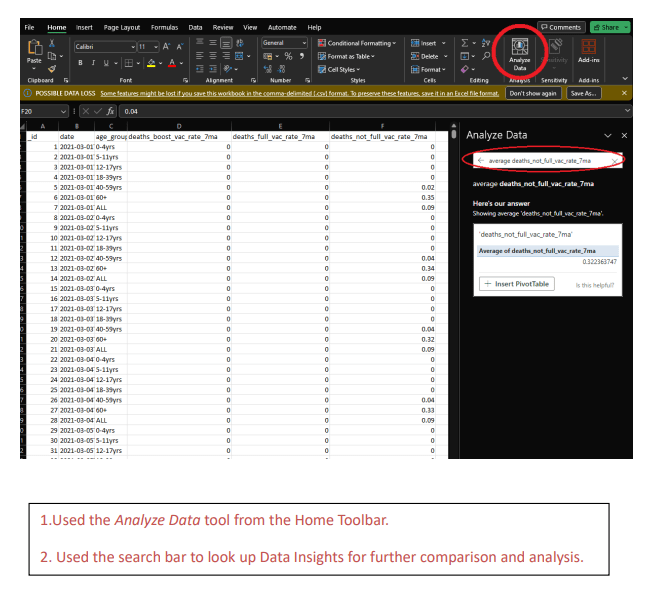
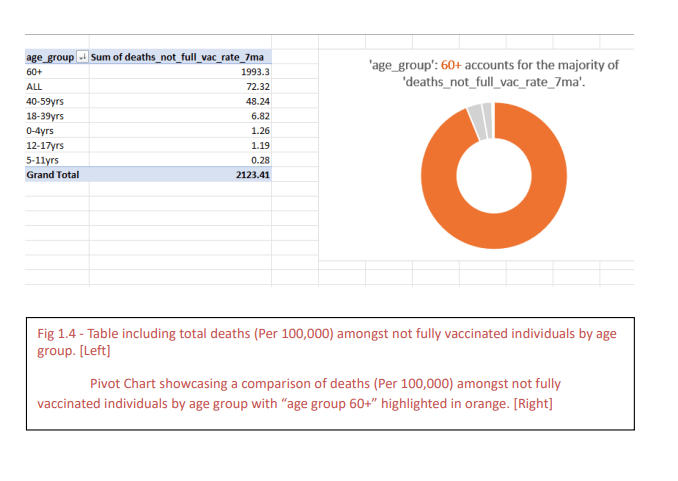
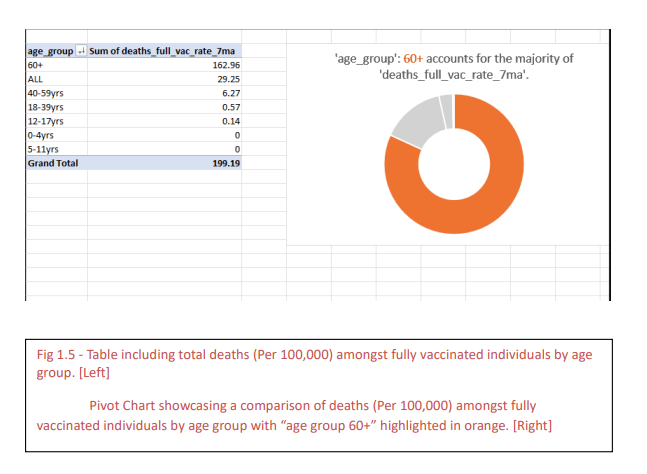
Furthermore, the analysed data can be classified by age group, which can help analyse the trends in mortality rate by age group. This can help the government give priority and curate measures for age groups that are more vulnerable to COVID-19. Using the Analyse Data tool to compute large figures of data, we come across the findings that individuals that come under the 60+ age group account for most deaths of individuals that aren’t fully vaccinated (See Fig 1.4). Upon computing the data by age group for individuals that are fully vaccinated (See Fig 1.5), the 60+ age group again makes up for the majority of the deaths, however, the figure is significantly smaller. Therefore, it is clear that the vaccination status of persons in older age groups plays an important influence in lowering death rates, emphasizing the need of vaccinating vulnerable populations.
The data analyzed can be extremely helpful for governments in curating health-care strategies for the public. However, the open-data catalogue has certain short-comings that cannot be overlooked. Firstly, the data does not include vaccination information for individuals who did not consent to their vaccination records being included into the provincial COVaxON system in addition to individual data as well as records from certain Indigenous communities who have refused to allow vaccination information to be included in COVaxON. (Ontario Data Catalogue, 2023) Moreover, public Health Units are constantly cleaning up COVID-19, correcting for missing or overcounted cases and fatalities as a result of regular data input and data quality assurance efforts in the Case and Contact Management system (CCM) file. As a result of these revisions, data spikes, negative numbers, and current totals may differ from previously reported case and death figures. (Ontario Data Catalogue, 2023) Open data is also susceptible to technical issues, where minor errors in counting and calculation can lead to thousands of contacts of confirmed cases not being reported or traced for weeks. For example, according to a report by CBC News, “Hundreds of confirmed cases of COVID-19 in the Toronto area were not flagged to public health officials because of a mix-up between two hospitals” (Crawley, 2020)
In conclusion, With the emergence of Web 2.0 and the formation of Gov 2.0 (Roy, 2014), open data proves to be a resourceful asset in keeping measure and curating to the public’s needs during a global pandemic. The development of open data and its availability to the public simply opens doors for improvement. “In considering the resiliency of ecological science to ongoing and future natural disasters, which are likely to become more frequent with climate change (Seneviratne et al. 2021), habitat loss (Gibb et al. 2020), and species exploitation (Dobson et al. 2020), it is important to highlight the lessons learned during this pandemic.” (Record et al., 2022) Open datasets such as the one analyzed in this certain analysis can also be interoperable with other datasets providing information on Covid-19 case rates by age, vaccination status, or hospitalization status for the government to develop an economically and socially viable action plan to protect individuals. The Government of Ontario also makes datasets available that prove to be beneficial to individuals by providing them with vital statistics and information on topics such as Covid-19 testing locations, Covid-19 alert impact data, Covid-19 zones in Ontario, Schools affected by Covid-19, etc. (Ontario Data Catalogue, 2023) “By contrast, open government is based upon the ‘notion that public sector information is a resource, the release of which will maximize its social and economic value to citizens.’” (Ubaldi, 2013). The data does have its limitations when it comes to technical issues, regular reporting of figures and the public’s consent to gather the data, however, it proves to be an immensely useful resource in forming public health policies and vaccination campaigns to mitigate the impact of COVID-19 in Ontario. With it’s ongoing and gradual development, the spread of Open-Data aspires to become a mutually beneficial asset for governments and their citizens.
References
Crawley, M. (2020, June 1). Toronto-area hospital failed to tell public health units about 700 positive tests for covid-19 | CBC news. CBCnews. https://www.cbc.ca/news/canada/toronto/covid-19-ontario-hospitalsmissed-telling public-health-confirmed-cases-1.5593572
Dobson AP, Pimm SL, Kaufman L, et al. 2020. Ecology and economics for pandemic prevention. Science
369: 379–81.
Gibb R, Redding DW, Chin KQ, et al. 2020. Zoonotic host diversity increases in human-dominated ecosystems. Nature 584: 398–402.
Ontario Data Catalogue. (2023). https://data.ontario.ca/ Record, S., Jarzyna, M. A., Hardiman, B., & Richardson, A. D. (2022). Open data facilitate resilience inscience during the COVID‐19 pandemic. Frontiers in Ecology and the Environment, 20(2), 76–77.https://doi.org/10.1002/fee.2468
Roy, J. (2014). Open Data and Open Governance in Canada: A Critical Examination of New
Opportunities and Old Tensions. Future Internet, 6(3), 414-432. https://doi.org/10.3390/fi6030414Seneviratne
SI, Zhang X, Adnan M, et al. 2021. Weather and climate extreme events in a changing climate. In: Intergovernmental Panel on Climate Change. Climate change 2021: the physical science basis. Contribution of Working Group I to the Sixth Assessment Report of the Intergovernmental Panel on Climate Change
V Masson-Delmotte, P Zhai, A Pirani, et al. [Eds]). Cambridge, UK: Cambridge
University Press.
Ubaldi, B. Open Government Data: Towards Empirical Analysis of Open Government Data Initiatives; OECD Work. Pap. Public Gov. 2013, 22, doi:10.1787/5k46bj4f03s7-en
 My Portfolio